Marketing for Landscaping Companies: How to Scale Your Business Past $1M
You've worked incredibly hard to build your landscaping operation to the seven-figure mark. But now you've hit an invisible ceiling. Every new lead, every estimate, every client issue seems to run directly through you.
You've grown your landscaping business to over a million dollars, but now it seems you've reached a ceiling. Every new lead, estimate, and client issue still comes to you.
Here's the tough truth: the issue isn't a lack of demand for your services. Growth is limited because the business relies on one approach to sales, estimates, and problem-solving.
Imagine a seamless system where every sales process is documented and repeatable, reducing the need for constant oversight. Clear systems save you time, help your team work independently, and allow the business to expand past current limitations by freeing you from daily bottlenecks.
Most advice out there is for smaller landscaping businesses. There's not much help for companies like yours that want to break past $1M and run smoothly without you always being involved.
Your main goal now is to build what we call an "Owner-Optional Enterprise"—a business that operates independently of your constant involvement, allowing you to focus on strategic leadership. A steady way to find quality leads is essential so your team can handle sales effectively while you concentrate on broader company growth.
This guide will show you how to build a business that runs independently. You'll learn how to set up marketing that works all the time, and we'll go over systems that help you turn leads into customers and grow as big as you want. Start implementing these steps today to take your company to the next level of growth. To get started immediately, focus on these first steps:
1. Document your sales process to ensure it's repeatable. Having a clear process allows your team to handle leads consistently without your direct involvement.
2. Identify and designate a key system or software that can automate some of your digital marketing or operational tasks.
3. Define roles within your team, assigning specific responsibilities to ensure the effective execution of each system.
To kickstart your journey, set aside 30 minutes now to identify every lead source and circle the one you personally manage today. Take this first step to ignite momentum and transform your business operations.
Key Takeaways
-
➔
The $1M revenue plateau often stems from owner dependency, not market demand.
-
➔
Successful scaling requires transitioning from hands-on operator to strategic leader.
-
➔
Building automated systems is crucial because they ensure consistent operations, reduce your workload, and allow your business to grow without your direct involvement, which matters more than chasing individual leads.
-
➔
Most available advice targets smaller businesses, leaving a gap for growth-focused companies.
-
➔
A self-sustaining marketing engine operates independently of the owner's direct involvement.
-
➔
Speed-to-lead processes can significantly improve conversion rates before competitors respond.
-
➔
The transition enables sustainable expansion beyond the $2M-$30M+ revenue range.
Understanding the $1M Plateau in Landscaping Businesses
After crossing the million-dollar mark, you may realize your landscaping company has hit a ceiling—not due to a lack of clients, but because of business structure. Good companies have plenty of work.
The real limit is how your business runs. You're probably doing many jobs—sales, estimates, managing projects, and fixing problems. Your company can only grow as fast as you can keep up.
Whenever a new customer calls, you're the one who answers, visits the property, gives the estimate, and closes the deal. This means your business can't make more money than the hours you have available.
GreenScape Solutions — Breaking Through the $1M Ceiling
Consider a theoretical story of GreenScape Solutions, a thriving landscaping company that reached $1 million in revenue but struggled to increase profits further. John, the owner, found himself juggling every aspect of the business, from client meetings to on-site assessments. With limited time in a day, the company's growth was tethered to John's availability, illustrating how owner dependency can cap growth potential.
By transforming its operational approach, GreenScape Solutions broke through this ceiling and paved the way for continued expansion with:
➔ Standardized estimating: Pricing no longer depended entirely on the owner's memory or availability.
➔ Dedicated lead handling: A system ensured inquiries were responded to quickly without requiring John to answer every call.
➔ Distributed responsibilities: Scheduling, client communication, and follow-ups were spread across team members with clearly defined roles.
This shift did not immediately reduce John's workload, but it changed the nature of his work. Rather than reacting to daily interruptions, he began focusing on higher-value decisions: improving margins, refining service offerings, and planning crew capacity. The business was no longer limited by how many hours he could personally invest in sales and administration.
Most online advice is for businesses with less than $2M in revenue. These tips are basic and don't help with the bigger changes you need to grow. Your competitors are likely facing the same daily struggles.
| Characteristics of Stuck Businesses | Characteristics of Scaling Businesses | Key Differentiators |
|---|---|---|
| Owner handles most sales | Team manages sales process | Delegated responsibility |
| Reactive problem-solving | Proactive system building | Strategic approach |
| Time-bound revenue growth | System-driven expansion | Scalable model |
| Dependent on owner availability | Independent operational systems | Reduced bottleneck |
Successful companies realize early on that the primary bottleneck isn't the market, the competition, or the economy. The bottleneck is inside the business.
Beyond the Burnout: Why Your Business Needs an Architect, Not a Hero
At this stage of your company's development, the most significant barrier to expansion might be your own daily involvement. When you handle every estimate, sales call, and client question, growth becomes tied directly to your available hours.
This creates a reactive cycle where urgent issues dominate your schedule. Strategic planning gets pushed aside for immediate firefighting.
To scale, you need systems that work without you. At this stage, your time is no longer just a resource—it's your most valuable asset.
If your landscaping company generates $1,200,000 per year and you work roughly 2,500 hours annually, each hour of your time supports about $480 in revenue.
Yet many owners still spend large portions of their week on tasks that could be delegated for $25-$50 an hour. That means using a $480-per-hour asset to do $25-$50 per-hour work.
That isn't a workload problem; it's a value mismatch. Every hour spent on low-leverage work is an hour stolen from pricing, growth, hiring, or strategy. To break the cycle, you have to move beyond three common traps:
1. The "Hero" Complex vs. The Architect
Many landscaping business owners pride themselves on being the "firefighter" who can fix any problem. But if you are the only person who can put out the fires, you've accidentally built a business that is a single point of failure.
Systems turn "tribal knowledge" into "company property." This shifts your role from the Operator (who does the work) to the Architect (who builds the machine that does the work). If you can't walk away for two weeks without the engine stalling, you don't have a business—you have a job.
2. The Hidden Cost of Decision Fatigue
High-leverage work—like negotiating a partnership or re-engineering your margins—requires massive cognitive energy.
When you spend your morning deciding which shipping vendor to use or answering basic customer emails, you are draining your "decision tank" on $25/hour problems. Systems prevent this loss of energy by handling routine decisions, preserving your brainpower for the $500/hour decisions that actually move the needle, and enabling your team to work efficiently without you.
3. The "Faster If I Do It" Fallacy
The most dangerous phrase in entrepreneurship is: "It's just faster if I do it myself." While true in the moment, it's a long-term mathematical trap. Doing a 30-minute task yourself every week costs you 26 hours a year. Spending 4 hours today to build a system for that task saves you 22 hours by year-end. Systems are investments that pay dividends over time.
Owner Bottleneck: Overcoming the Primary Salesperson Challenge
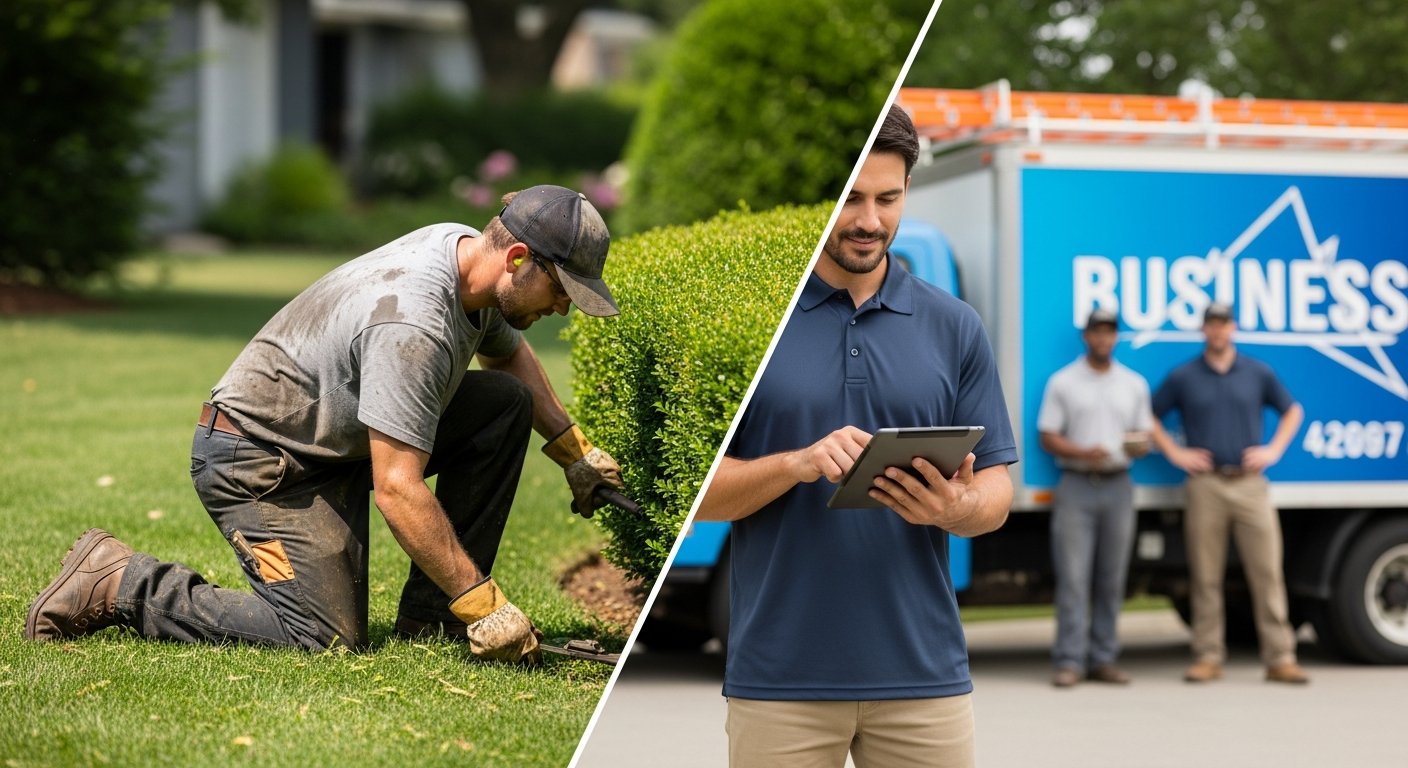
At this point in your business, the biggest thing holding you back might be how involved you are every day. If you handle every estimate, sales call, and client question, your growth is limited by your own time.
Scaling Through People: The Art of the Clean Handoff
True delegation isn't about "getting rid of work"—it's about moving tasks to their highest and best use. To move from owner-dependent work to scalable growth, you have to clearly separate what only you can do from what your team—or your systems—should handle.
The Strategic vs. Operational Audit
The first step in freeing your time is a simple task audit. Write down everything you do in a typical week and place each task into one of two buckets:
➔ Strategic (high-leverage): Major partnerships, long-term planning, pricing decisions, and financial direction—work that directly shapes the business's future.
➔ Operational (repeatable): Scheduling, responding to initial inquiries, routine follow-ups, and basic sales calls.
Your goal is to steadily offload the operational bucket. If a task follows a repeatable pattern, it belongs in a checklist—not in your head. If it can be written once, it can be taught forever.
Building the Playbook
Delegation breaks down when expectations are unclear. A clean handoff requires three things:
➔ The Framework: A checklist or SOP that clearly shows how the task is done.
➔ The Tools: Access to the software, information, or templates needed to complete the work without constant approval.
➔ The Feedback Loop: Regular check-ins to review results and refine the process. This isn't micromanagement—it's quality control.
When your team handles the daily execution, you gain more than time back. You gain consistency, professionalism, and a business that doesn't stall when you step away. That's what turns delegation into real scale.
| Reactive Approach | Proactive Approach | Resulting Impact |
|---|---|---|
| Owner handles all sales | Team manages sales process | Scalable growth |
| Constant client firefighting | Systematic service delivery | Reduced stress |
| Time-bound revenue | Independent operations | Higher margins |
| Broad service offering | Focused specialty areas | Better quality |
Transitioning from Field Operator to Strategic Leader
As your role changes, you'll spend less time working with equipment and more time figuring out what makes your business most profitable. Find out which customer types generate the best profits, and set up systems to consistently generate high-quality leads.
The goal isn't to work harder, but to change how your business runs. When sales and service are handled by systems, you're free to focus on big decisions that help your company grow.
Marketing for Landscaping Companies: Establishing an Independent Lead System
To move from owner-dependent work to scalable growth, you need a lead-generation system that runs while you sleep.
The reality of the modern market is that your customers are doing their homework long before they ever talk to you. If your website isn't attracting them early in that research phase, you've already lost the race.
The Math of Predictability
Systems take the "mystery" out of revenue. Instead of guessing how next month will look, a system allows you to work backward from a measurable goal.
Consider the "Success Equation":
The Success Equation
5
Leads/week
40%
Close rate
2
New customers/week
$124,800
Annual revenue
At an average customer value of $1,200/year, those 5 leads per week translate to $124,800 in annual revenue.
When you have a benchmark, you gain a dashboard. If your revenue dips, you don't have to panic; you simply look at the data. Is the bottleneck in the number of leads or the close rate? When you know the numbers, you know exactly where to focus your energy.
Breaking the Word-of-Mouth Trap
If your business relies on referrals, you've built your growth on something you can't control. Word-of-mouth works, but it's inconsistent. The moment you add structured lead-generation channels—such as SEO, paid ads, and email follow-ups—you gain predictability.
Multiple lead sources act as insurance. When one channel dips, another picks up the slack. The goal is never to replace referrals, but to build alongside them so your pipeline doesn't depend on luck.
Creating a Marketing Flywheel for Sustainable Growth
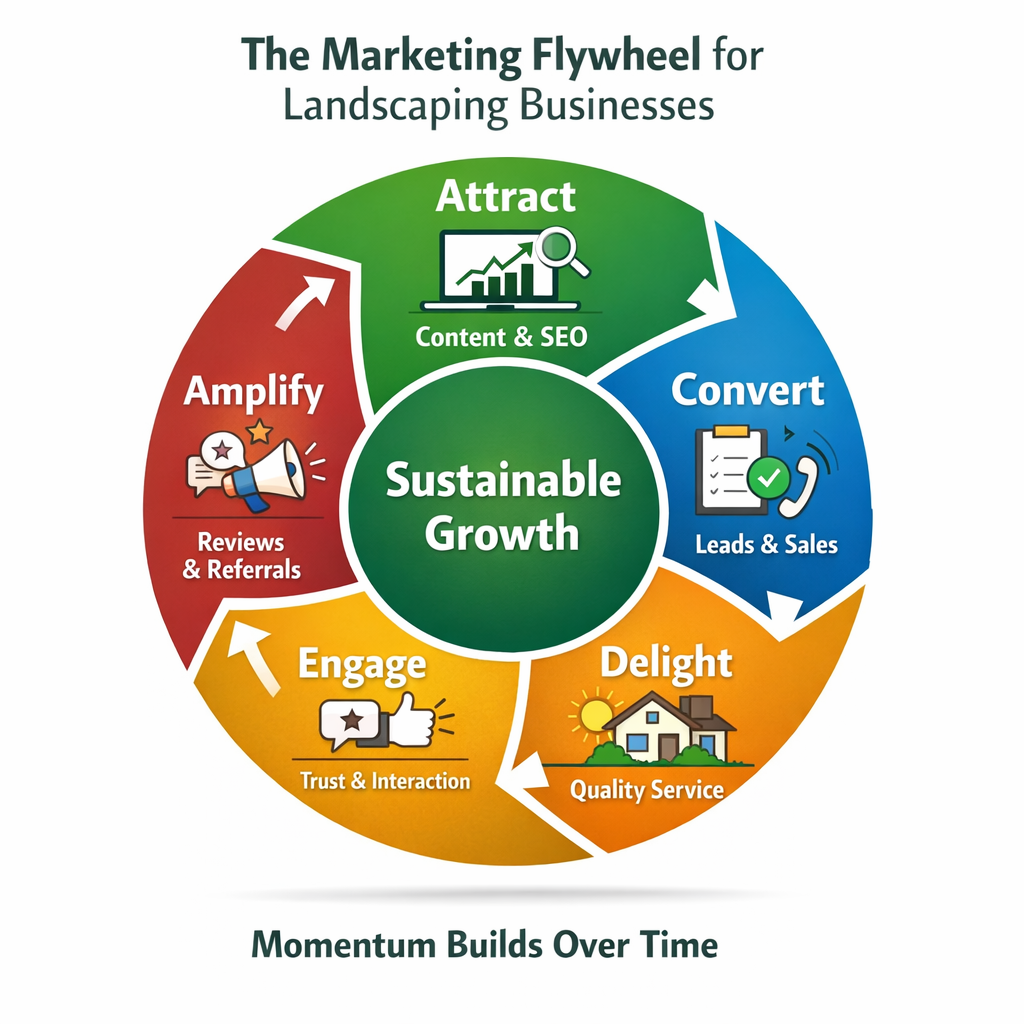
The most resilient landscaping companies don't rely on a single marketing channel. They build a flywheel—a cyclical growth model that puts satisfied customers at the center. Unlike a traditional funnel where prospects enter at the top and often drop off at the bottom, a flywheel keeps spinning. Every happy customer adds momentum, generating referrals, reviews, and repeat business that feed right back into growth.
The flywheel works across three stages:
➔ Attract: Drawing in the right prospects through content, SEO, and ads.
➔ Engage: Converting them with a seamless sales and service experience.
➔ Delight: Exceeding expectations so they become advocates who bring in more business.
Your job as a business owner is to add force to each stage—through better marketing, faster follow-up, and higher-quality work—while reducing friction wherever customers have a poor experience. When you do both, the flywheel accelerates on its own.
Here's how the flywheel works in practice:
Service completed successfully
Customer has positive experience
Business requests review with correct timing + wording
Some percentage of customers respond
Reviews accumulate
Trust signals strengthen
Conversion rates improve
The flywheel takes effort to start, but once it's moving, each revolution gets easier. Every new review, every blog post, every ad impression compounds over time. This is the difference between chasing leads and building a machine that generates them.
Traditional Marketing (Linear)
Run ads → Get leads → Leads stop → Spend more
This creates constant pressure and unpredictable acquisition costs. You're always paying to restart the engine.
Flywheel Marketing (Compounding)
Build assets → Assets generate leads → Leads create proof → Proof strengthens assets
Over time, marketing becomes more efficient rather than more expensive. Instead of repeatedly "buying attention," you accumulate visibility and trust.
Implementing Automation for Lead Generation
As your landscaping business grows, manual lead management becomes an obstacle. Automation tools keep your pipeline running without your constant attention. These tools take the manual work off your plate and make sure leads are being nurtured consistently.
Here's what the shift from manual to automated looks like in practice. Each of these swaps eliminates a daily headache and frees up hours every week—plus, most of these tools offer free tiers or affordable plans built for small service businesses.
Before
Manually logging leads
After
CRM auto-capture
Before
Individual follow-up emails
After
Automated sequences
✓ Consistent timing
Before
Spreadsheet tracking
After
Pipeline dashboard
✓ Real-time visibility
Try: ServiceTitan, Monday.com, Jobber
Before
Memory-based scheduling
After
Calendar integration
✓ Zero double-bookings
Try: Calendly, Housecall Pro, LawnPro
When evaluating automation tools, prioritize ease of use, integration with your existing software, and features relevant to service-based businesses. Many platforms offer trial periods—test them with real workflows before committing.
Embracing Speed-to-Lead Strategies
The speed at which you respond to a new inquiry is one of the most critical factors in winning the job. Research from MIT shows that leads contacted within five minutes are 100 times more likely to reach prospects than those contacted after 30 minutes.
Think of it this way: the first company to respond professionally and promptly sets the bar. Every competitor who responds later is measured against that first impression. This is where automation shines—auto-responses, instant booking links, and CRM alerts make sure your team never misses that golden window.
The most common mistake landscaping companies make is treating follow-up as optional. A structured follow-up cadence—immediate auto-reply, personal call within the hour, follow-up email within 24 hours—turns a one-time inquiry into an ongoing conversation.
Many owners resist automation because it feels impersonal. But the reality is this: a fast, helpful auto-response followed by a personal call is far better than a delayed personal response—or worse, no response at all.
Your competitors may be slow to respond. That's an opportunity. By committing to the fastest, most organized follow-up in your market, you gain a measurable edge that compounds with every lead. As Mark Bradley of LMN famously put it, taking massive action in your follow-up is your unfair advantage.
Leveraging Digital Marketing: SEO, Content, and Website Optimization

Today, 78% of people research before buying. Your website has to attract them early in that research process. If you're not showing up when they're searching, you're invisible—and your competitors are getting those calls instead.
Investing in digital marketing gives your landscaping company the tools to capture leads at scale—through search engines, social media, and targeted ads—without relying solely on word-of-mouth.
Content Marketing: Attracting Prospects with Value
Content marketing positions your company as the local authority. By publishing helpful, relevant content—such as seasonal lawn care guides, project spotlights, or landscaping FAQs—you attract homeowners who are actively researching services.
This content serves a dual purpose: it builds trust with potential customers and signals to search engines that your website is a valuable resource. The result is higher organic rankings and more qualified traffic without paying for every click.
Website Optimization for Conversions
A great website isn't just about looking professional—it's about converting visitors into leads. Every page should have a clear call to action, fast load times, and mobile-friendly design. If a homeowner lands on your site and can't immediately figure out how to request an estimate, you've lost them.
Key elements include prominent contact forms, click-to-call buttons, trust signals (reviews, certifications, before/after photos), and clear service area pages. These aren't extras—they're the foundation of a site that actually generates business.
Local SEO: Dominating Your Service Area
For landscaping companies, local SEO is the single highest-ROI marketing channel. When someone searches "landscaping near me" or "lawn care in [your city]," you need to be in those top results.
This means optimizing your Google Business Profile, building local citations, earning reviews, and creating location-specific content. Local SEO compounds over time—the work you do today continues to generate leads months and years from now.
Email Marketing and Direct Mail: Re-Engaging Past Clients
Your past customers are your warmest leads. A structured lawn care email marketing strategy keeps your brand in front of previous clients, reminding them of seasonal services and encouraging repeat business.
Personalization matters. Segment your list by service type, property size, or last service date—and send targeted messages that feel relevant, not generic. A well-timed email about spring cleanup or fall aeration can reactivate dormant accounts with minimal effort.
Direct mail still works in local markets. A professionally designed postcard arriving at the right time can stand out in a digital-only world. The key is consistency—regular touchpoints keep your company top of mind when the homeowner is ready to buy.
Utilizing Social Media, Paid Ads, and Referral Programs
Social media gives landscaping companies a visual platform to showcase their best work. Before-and-after transformations, time-lapse videos, and customer testimonials build credibility and keep your brand visible. Research shows that consumers research brands on social media before purchasing, making your presence there essential.
Paid advertising—Google Ads, Facebook Ads, and Instagram promotions—puts your services in front of homeowners who are actively searching or who match your ideal customer profile. The advantage of paid ads is immediate visibility and precise targeting by location, demographics, and interests.
Referral programs turn your happiest customers into a sales force. A simple incentive—a discount on their next service, a gift card, or a charitable donation in their name—encourages clients to spread the word. Nielsen reports that eight-in-ten people trust recommendations from friends and family, making referrals one of your highest-converting lead sources.
Actively solicit reviews after every completed project. A simple follow-up text or email with a direct link to your Google Business Profile makes it easy for satisfied clients to leave feedback. These reviews fuel your local SEO, build social proof, and directly influence whether a new prospect chooses you or a competitor.
Advanced Branding and Messaging
Your brand is more than a logo. It's how customers feel when they interact with your company. To stand out, your messaging should focus on the problems you solve—not just the services you offer.
Instead of "We do landscaping," try "We help busy homeowners reclaim their weekends with a yard they're proud of." This shift from features to benefits creates an emotional connection that makes your company memorable.
Every marketing asset should make the next step obvious. Whether it's calling for a consultation or requesting an estimate, remove friction points. This approach aligns with advanced marketing strategies that consistently attract ideal clients.
Create a style guide for your brand. Make sure your website, uniforms, and proposals all look consistent. This builds recognition and shows you're professional.
The Infrastructure of Growth: Turning Data into a Force Multiplier

A business can only grow as far as its systems can reach. The real turning point for your company happens when you stop relying on individual heroics and start relying on repeatable processes. To move from working in the field to leading from the front, you need an infrastructure that delivers consistent quality—no matter how big your team gets.
1. Stop Guessing, Start Tracking
Top-tier companies don't "feel" their way to growth; they calculate it. By tracking detailed numbers—such as close rates, average proposal values, and "lost deal" reasons—you move from intuition to insight. Data allows you to fix the specific gear that is broken rather than trying to overhaul the whole machine.
2. The Fortune is in the Follow-Up
One of the easiest systems to automate is lead nurturing. A prospect who wasn't ready for a landscaping project six months ago might be ready today. Instead of relying on your memory, sales automation tools can:
Send automated follow-ups to keep your brand top-of-mind.
Centralize interactions so no lead falls through the cracks as you scale.
Reduce friction for the customer, making it easier for them to say "yes."
3. Profitable Proximity: Strategic Service Areas
Growth doesn't just mean "more"; it means "smarter." A common mistake is taking jobs anywhere just to keep the crew busy. A scalable system analyzes where you work most efficiently.
By evaluating travel time, logistics costs, and job profitability by region, you can define a "High-Value Zone." Focusing your efforts on these specific areas ensures that as your revenue grows, your margins don't shrink under the weight of windshield time and logistical headaches.
The Result: As these operational systems take hold, your role changes. You stop being the person who makes the business work and start being the person who decides where the business goes next.
| Reactive Approach | Systematic Strategy | Business Impact |
|---|---|---|
| Individual heroics | Documented processes | Consistent quality |
| Guesswork decisions | Data-driven improvements | Better results |
| Lost prospect opportunities | Systematic re-engagement | Additional revenue |
| Manual tracking | Automated workflows | Higher efficiency |
Conclusion
To grow past a million dollars, you need to move from reacting to problems to running your business with systems. Your marketing should also change to support this new stage.
The best lawn companies set up a marketing system that runs autonomously. Different channels work together to generate high-quality leads 24/7. This approach gives you steady results without needing your constant attention.
You become a strategic leader when you let trained team members handle sales and operations. This gives you time to focus on growing your business and building your brand. The right marketing turns your business into a self-sustaining machine.
Now is the moment to implement these proven approaches. Start with one area where you'll see immediate impact. A high-impact starting point could be automating your lead response. By quickly responding to incoming leads, you set the tone for speed and efficiency, significantly boosting your conversion rates. Alternatively, documenting the sales process ensures consistency and frees time for you to focus on strategic activities. Build that system until it runs independently, then tackle the next priority.
Your business can move past its current limits when you use systems instead of always putting out fires. Making this mindset shift is the first step from being a field worker to becoming a strategic leader.
Ready to Scale Past $1M?
You've built a great landscaping business—now it's time to build the marketing system to match. Get a free audit and we'll show you where the biggest growth opportunities are hiding.
Get Your Free Marketing Audit