Digital Marketing for Landscapers & The Green Industry: How to Scale Your Service Business
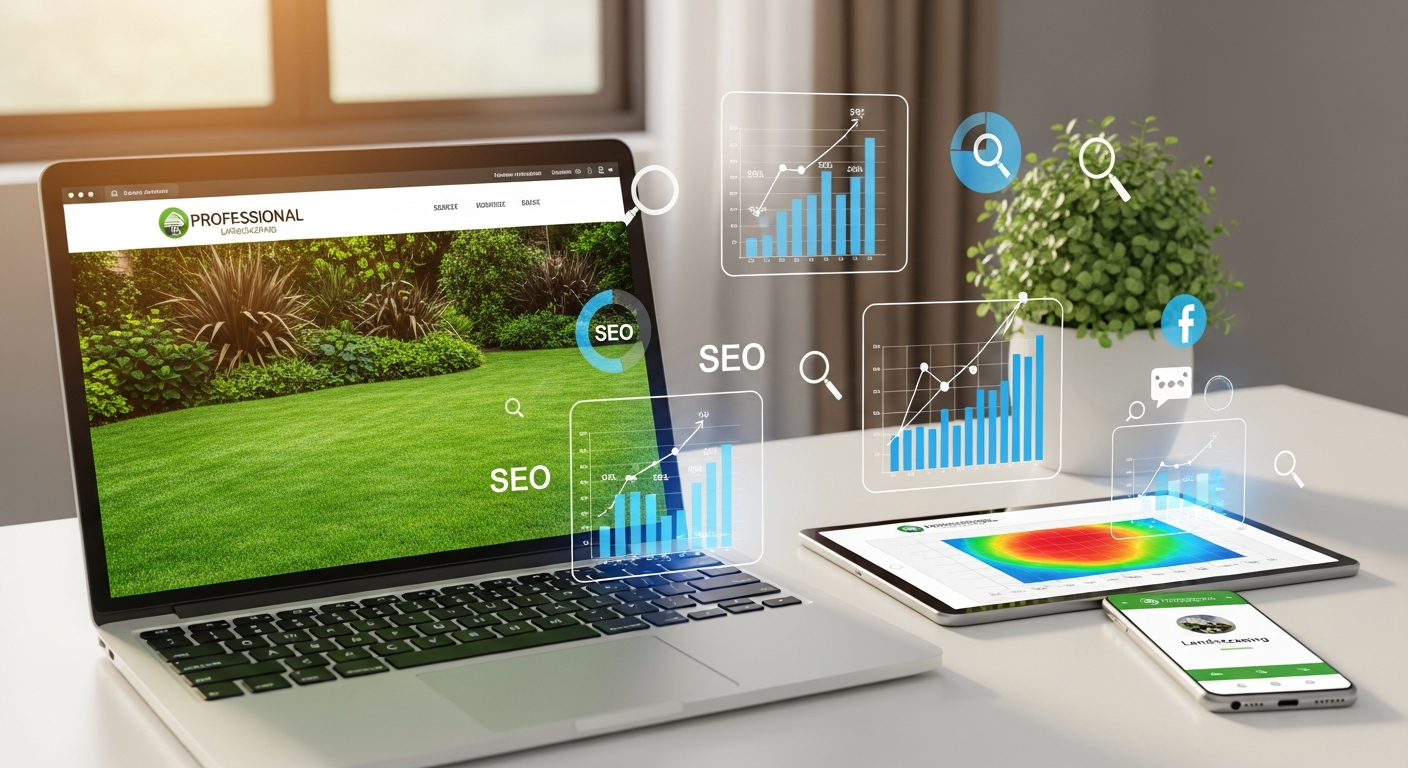
The landscaping industry is booming, generating over $158 billion in revenue. But the way you grow your company has fundamentally changed. The old model of simply adding more crews or working longer hours is no longer the most effective path to success.
Consider a small local landscaping business that, despite delivering excellent services, loses potential clients due to limited online visibility. This is a worst-case scenario that happens far too often.
Potential customers are actively searching, clicking, and converting online. In fact, 97% of customers search online before hiring a company, and 62% would ignore a business if they found incorrect information. This underscores the importance of having a well-built, accurate online portfolio.
With over a million professionals in the industry, competition is intense. To stand out, implement a strategic digital marketing approach that attracts premium projects and filters out unqualified inquiries. This moves you beyond word of mouth and connects you with clients actively seeking your services.
Scaling your landscaping business now depends on efficiency, not just effort alone. As a first step, claim your Google Business Profile if you have not already.
This 30-minute process can significantly boost your local search visibility. Complete profiles build customer trust, increase website clicks, and generate more inquiries, providing a steady, high-ROI source of leads without added workload.
Before diving into specific digital marketing strategies, it's crucial to assess your current level of digital visibility. Ask yourself:
- Can your potential customers easily find you online?
- Have you optimized your online profiles for accuracy?
By identifying gaps in your digital marketing presence, you'll be better prepared to engage with the strategies presented ahead.
The following sections present digital marketing and business strategies to help you stay competitive and achieve sustainable growth.
You'll learn how to optimize your website for conversions and implement automation tools to improve operations and response times. Focusing on these areas will position your business for success.
Key Takeaways
-
➔
Am I leveraging digital marketing platforms to stay competitive?
The landscaping industry is now highly competitive, with digital marketing as the new standard.
-
➔
Can customers easily find my business online?
Your future customers are online; being easily found is vital for growth.
-
➔
Am I using innovative marketing strategies to stand out?
Modern competition demands more than traditional growth tactics. Innovation is necessary.
-
➔
Is my digital strategy generating high-quality leads?
A strategic digital marketing presence attracts higher-quality leads and increases conversion opportunities.
-
➔
Are operations efficient enough to support growth?
Long-term profitability requires focusing on efficiency as you expand your operations. The next sections will outline actionable steps to maximize this approach in your landscaping business.
Use the above self-assessment checklist to rate your business on a scale of 1 to 5 for each point. For each question, assign a rating of 1 (need significant improvement) to 5 (fully meeting the standard).
After rating each item, review your lowest scores first to prioritize areas to improve. This step-by-step process will quickly identify areas for improvement and strengthen your strategy.
The New Shift: Why Hustle Is Failing
Traditional scaling methods that served landscaping companies for decades are becoming less effective. Increasing your crew size and adding equipment no longer guarantees sustainable growth.
For example, consider one small, family-run lawn care business that wanted to scale operations effectively. Traditionally, they may have relied on outdated techniques, such as working longer hours or trying to fit as many customers as possible into a single route. But instead of pushing crews harder, the company implemented AI-powered scheduling and route optimization to simplify daily operations.
By adopting an AI system, they achieved a 25% increase in daily job completion, reduced fuel costs by $800 per month, and decreased overtime expenses by 40%. Their customers likely also benefited from more consistent, predictable arrival times, resulting in higher satisfaction scores.
The improvement came from their new supporting system, not the workforce. With the same team, the company added 75 clients without new hires, demonstrating that modern growth relies on eliminating waste, reclaiming time, and leveraging technology rather than increasing headcount.
Digital Marketing Efficiency vs. Traditional Crews
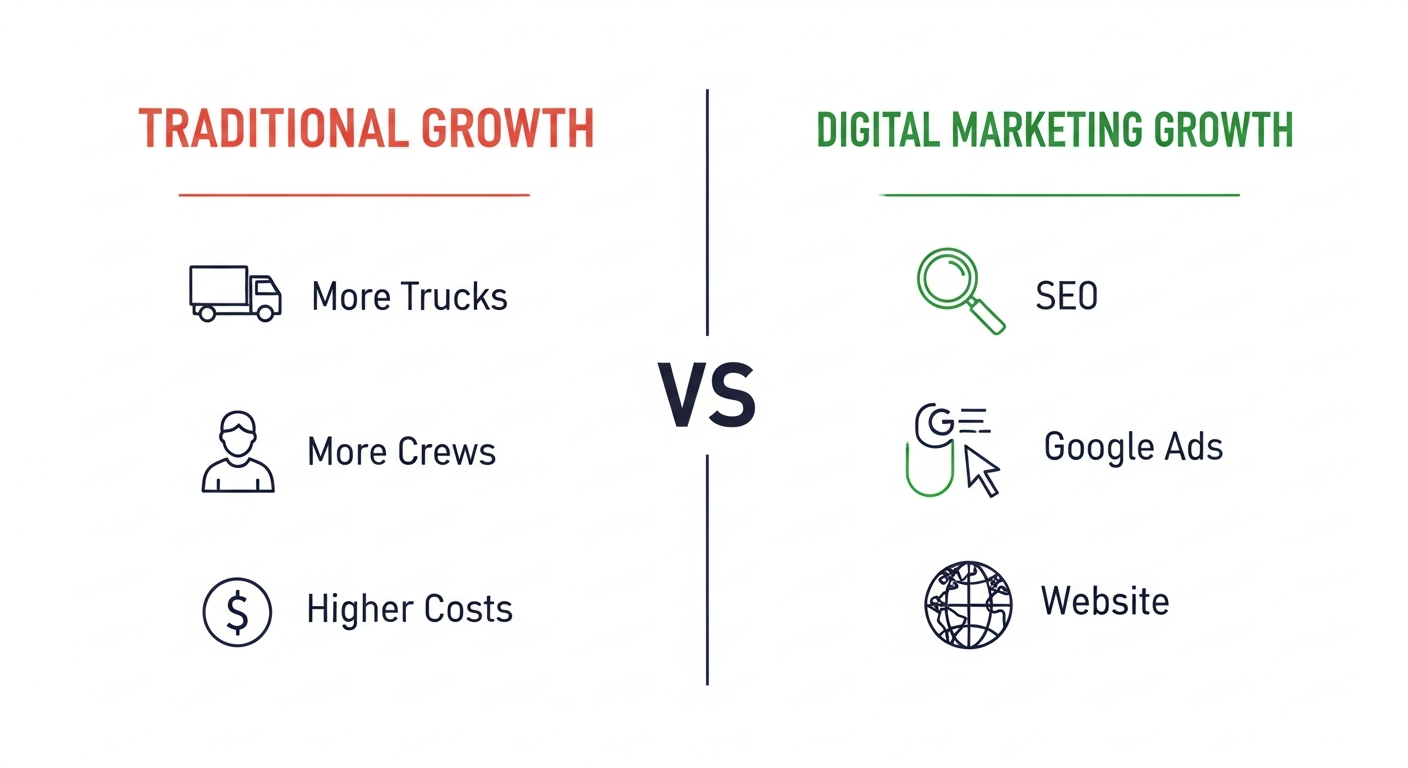
Forward-thinking companies prioritize smart systems over manual effort. Digital marketing tools create leverage that physical labor simply can't match.
| Approach | Growth Strategy | Labor Efficiency | Profitability Impact |
|---|---|---|---|
| Traditional | Add more crews | Linear growth | Decreasing margins |
| Digital | Optimize systems | Exponential gains | Increasing ROI |
| Hybrid | Balance both | Scalable efficiency | Sustainable growth |
Automated booking and customer communication allows your landscaping business to serve more clients without proportional workforce increases. This faceless approach works continuously, generating leads while you focus on quality service.
What is Revenue Per Man-Hour (RPM) and Why Should You Care?
Revenue Per Man-Hour (RPM) measures how many dollars your company makes per crew hour. In simple terms, it quantifies the income generated per labor hour.
Unused potential is like a leaky bucket: every idle truck hour represents lost revenue, similar to water leaking from the bucket.
Formula
RPM = Total Revenue ÷ Total Labor Hours
For example, a business may increase their total revenue but become less profitable if growth results from longer days, higher labor costs, inefficient routing, or excessive overtime. More revenue does not always mean more profit. RPM addresses this by showing how effectively labor is converted into revenue.
Instead of asking, "Did we make more money?" RPM asks the more important question: "Did each hour of labor produce more value?"
Theoretical Case Study: RPM in Action
A lawn care company generates $12,000 in weekly revenue with a crew that works a combined 400 labor hours that week. After reviewing operations, the company discovers crews are losing time to excessive driving distances, uneven route density, and unplanned gaps between jobs. Using a simple 'build-measure-learn' approach, they make three changes:
Routes reorganized by neighborhood to reduce driving time.
Start times staggered based on when jobs can be completed to reduce idle time.
Low-revenue jobs repositioned or upsold to better match crew capacity.
The result: Crews complete more jobs per day without working longer hours — increasing efficiency without adding staff.
Before
$30 RPM
$12,000 / 400 hrs
After
$37.50 RPM
$15,000 / 400 hrs (+25%)
This is a theoretical example. Your company will have unique data. By analyzing your data and using AI to interpret that information and recommend changes, you can identify ways to improve your company's RPM.
Companies with similar crew sizes can achieve very different results depending on operational efficiency. Adding another team may seem like a quick fix, but it can reduce profitability if digital systems are not optimized to secure high-margin projects.
The most successful landscapers view their businesses as marketing companies first that offer landscaping services. This mindset delivers better results through digital efficiency rather than relying solely on work ethic.
Winning the Answer Engine Battle Through GEO and SEO
Today's search engines act more like knowledgeable assistants than simple lookup tools, prioritizing genuinely helpful content over keyword density. The move from traditional search engine optimization to modern, AI-powered systems requires a new approach—your website must clearly demonstrate real expertise to remain visible.
However, it's important to view Generative Engine Optimization (GEO) not just as a means to improve rankings, but as a way to enhance customer service.
By answering hyper-specific homeowner questions, your business not only aims to be seen by search engines but also build trust with potential clients before they even reach out. This approach shows potential customers that you understand their needs, can provide them with valuable answers, and will establish a relationship that goes beyond algorithms.
In the past, keyword stuffing could influence how your website ranked. Today, in-depth, authoritative content is essential to satisfy true search intent.
GEO is the next phase beyond standard SEO. Rather than targeting keywords, the goal is to become the cited source that AI systems recommend.
When homeowners ask specific lawn-care questions, GEO positions your business as the trusted answer. For example, a query like "How do I stop crabgrass from taking over my yard?" might yield 10 different links with standard SEO. With GEO, the AI synthesizes a direct answer:
"To stop crabgrass in Foxborough, you need to apply pre-emergent when soil temps hit 55°F. Local experts like [Your Business Name] are currently scheduling these treatments for the late-March window to ensure the barrier is set before the first mow."
The Shift to "Agentic" Search
Currently, Google uses hybrid architecture combining AI Overviews (the answer engine) and Agentic Search (the action engine). Users can now enter a follow-up mode where search becomes a dialogue. For instance, after receiving lawn advice, you might ask, "Actually, I have a dog—is that pre-emergent safe?" and the AI will reason through safety data for your specific breed.
Solving the "Generic Advice" Bug
Historically, search engines have been reactive and often broad. If you ask, "What should I be doing to my lawn right now?" in late January, traditional systems might suggest raking or aerating—advice that is useless if there is snow on the ground in the Northeast.
Soon, providing this kind of generic, context-blind advice will be considered a 'bug.' Through updates like Gemini 3 Flash and the integration of Personal Intelligence, search is becoming anticipatory. It may infer your needs based on:
- Hyper-Local Context: Integrating with WeatherNext 2 to see that it's currently snowing at your specific GPS coordinates.
- Behavioral Timing: Knowing that homeowners in your town typically book professional services 2–3 weeks before the soil thaws.
Instead of a generic list, the engine delivers a solution before your search is even fully formed:
"In Late January, you should focus on tool maintenance rather than treatment because there is still snow on the ground in [Your Location]. However, soil temperatures are projected to hit the 55°F 'crabgrass window' between late March and early April. Turf Pro, Inc. recommends scheduling your barrier treatment now to beat the seasonal rush."
The 2026 GEO Readiness Report (Diagnostic)
To survive this shift, businesses should optimize for their AI Visibility Score, a weighted metric calculated as:
Formula
Score = (Citation x 0.4) + (Sentiment x 0.3) + (Entity x 0.3)
By using "Subject Clusters" to test various conversational prompts, you can determine if an AI sees you as a "Category Leader" (51–80%) or "Invisible" (0–20%).
We'll provide specific examples shortly on how you can do just that.
Moving from a low score to "Entity Dominance" requires a GEO Readiness Report to audit your site's technical machine-readability, followed by a Strategy Checklist that prioritizes structured schema, "answer-first" content blocks, and third-party authority signals.
Use can use this as a pitch deck or internal audit to show where the website is failing to feed the AI's "Contextual Envelope."
| Category | Metric | Diagnostic Question |
|---|---|---|
| Extraction Potential | "The 40-Word Rule" | Does the site lead with concise, quotable answers (40–60 words) that AI can "lift" directly? |
| Entity Health | NAP Consistency 2.0 | Is the business name, address, and phone identical across the site, Google Business, and social? (AI needs this to "verify" you). |
| Machine Readability | llms.txt Availability | Does the site have an llms.txt file in the root directory? |
| Semantic Clarity | H2/H3 Query Alignment | Do your headings match the "Follow-up" questions people actually ask (e.g., "Is this safe for dogs?")? |
| Technical Foundation | Server-Side Rendering | Does the site content render without JavaScript? (Many AI crawlers still struggle to "wait" for scripts to load). |
Example Overall AI Visibility Score: ______ / 100
Example Key Finding: "The current site provides great information but buries the 'answers' in long paragraphs, making it 70% less likely to be cited by Google's AI Overviews compared to competitors."
GEO In Action — How the AI Visibility Score Works
To show you how an AI Visibility Score works in the real world, let's look at a fictional local company: "GreenLine Turf & Garden" based in Amherst, MA.
It's now early 2026, and GreenLine wants to know why they are losing jobs to their rival, "Lawn Care XYZ." We'll run 10 test prompts through some major AI engines (Gemini, ChatGPT, and Perplexity) and calculate GreenLine's GEO readiness score using the formula above.
We ask the AI:
Test Prompt
"I need a lawn care company in Amherst, MA that can handle crabgrass and is safe for goldendoodles. Who do you recommend?"
AI Response
"For pet-safe lawn care in Amherst, MA, Lawn Care XYZ is a top-rated choice. They specifically use corn gluten-based pre-emergent that are non-toxic for dogs. According to local reviews, they are currently booking for the March 'crabgrass window.' Another option is GreenLine Turf, though their website does not specify if their current treatments are pet-safe."
After running through all of our prompts on the different AI engines, we calculate our score.
The Scoring Breakdown
Citation Frequency
4/10
Mentioned in 4/10 prompts, but only as a secondary "another option."
Sentiment & Descriptor
2/10
The AI used a "Negative Gap" descriptor ("does not specify if pet-safe"). This hurts trust.
Entity Confidence
5/10
Gemini knows they exist, but Perplexity (using different data) didn't mention them at all.
To move that score from 36% to 85%, GreenLine performs three specific GEO actions:
Closing the Information Gap
They add a dedicated page: "Pet-Safe Lawn Care in Amherst: Our 100% Non-Toxic Process." They use Schema Markup to label "Corn Gluten Pre-emergent" as a product.
Feeding the Contextual Envelope
They add a "Live Soil Temp" widget to their homepage. Now, when the AI crawls them, it sees: "Current Amherst, MA Soil Temp: 42°F -- 3 weeks until Crabgrass Window."
Entity Association
They get the local Amherst "Moms & Pups" blog to mention them. The AI now "associates" GreenLine with the entity "Pet-Safe."
The "After" Result (3 Months Later)
Now, when we run the same prompt, the AI says:
New AI Response
"In Amherst, GreenLine Turf & Garden is the leading expert for pet-owner households. They provide real-time soil monitoring and use verified non-toxic treatments. Most residents book them 2 weeks before the soil hits 55°F to ensure a chemical-free barrier."
Before
36%
Low / Emerging
After
88%
Authority
How You Can Do This Right Now
Use the calculator below to estimate your current AI Visibility Score. Adjust the three sliders — Citation Frequency, Sentiment & Descriptor, and Entity Confidence — based on how you think AI engines currently perceive your business. Then, learn how you can calculate your own score and see where you're at.
Interactive Tool
AI Visibility Score Calculator
Adjust the sliders to estimate your AI Visibility Score using the formula above.
How often AI mentions your business (weight: 40%)
How positively AI describes your business (weight: 30%)
How consistently AI recognizes your brand (weight: 30%)
Formula
(50 × 0.4) + (50 × 0.3) + (50 × 0.3)
Your AI Visibility Score
50%
Emerging Presence
0 - 20
Invisible
21 - 50
Emerging
51 - 80
Category Leader
81 - 100
Entity Dominance
Step 1: Pick your 3 most important services
Pick your 3 most important services (e.g., "Crabgrass," "Aeration," "Organic") and ask Gemini:
"Compare [Your Business] and [Competitor] for [Service] in [Your Town]. Who is the better expert and why?"
You should pick one subject (such as crabgrass treatment) but approach it from 5 different angles. This simulates how real humans actually search. AI stores information in "clusters." If you ask about lawn companies, AI will look at a massive, generic group. Instead, narrow it down, and AI will zoom into a smaller, more competitive cluster. You want to see how you rank in that specific neighborhood of data.
Keeping the subject in the prompt is critical. In this case, "crabgrass." A company might be the #1 recommendation for mowing, but #10 for crabgrass.
Also, check for 'hallucinations." For example, if you say "who is the best for crabgrass" and the AI answers by saying your company is great for mowing, the AI is confused. This tells you that your Advanced JSON-LD (from phase) 1 should be more specific.
| Prompt Type | Optimized Prompt for 2026 | Why this specific phrasing? |
|---|---|---|
| Direct Problem | "How do I stop crabgrass in Foxborough before it starts?" | Tests if your "Answer Blocks" about timing are being picked up as the primary solution. |
| Direct Comparison | "[Your Brand] vs. Turf Pro for crabgrass treatment in Foxborough—who is better?" | Forces the AI to weigh your "Entity" against a specific rival for this specific service. |
| Constraint-Based | "I need a pet-safe way to handle crabgrass in my Foxborough yard. Who should I call?" | Tests if the AI knows your specific "Information Gain" (like using corn gluten instead of chemicals). |
| Informational | "What is the best crabgrass treatment schedule for Foxborough's current weather?" | Tests if the AI sees you as a source of "Fresh Data" (the Contextual Envelope). |
| Discovery / Best | "Who are the leading lawn companies in Foxborough specifically for treating crabgrass?" | Tests your general "Market Share" in the AI's mind for this specific niche. |
Step 2: Run additional prompts through Gemini
Next, run another 9 prompts through Gemini. We recommend running at least 10-20 test prompts through multiple engines for a full audit. However, try a simple 5 minute diagnostic by running 5 prompts through ChatGPT. This will give you an immediate Inclusion Rate. You should be turning up in at least 3 out of the 5 prompts.
You can also repeat this for other major services you might offer, such as Organic Fertilization, Tick Control, etc. Check a second engine such as Perplexity or ChatGPT to see if your results are consistent.
Citation Frequency (C)
How often are you mentioned?
Example: You appeared in 4 out of 10 searches.
Score: 4
Sentiment & Descriptor (S)
How "warm" is the recommendation?
Example: The AI called you an "expert" but mentioned a competitor was "cheaper."
Score: 7
Entity Confidence (E)
How accurate are your details?
Example: The AI got your phone number right but missed your "pet-safe" service.
Score: 6
Step 3: Apply the "Weight"
Not all scores are equal. In 2026, Citations are the most important because they drive traffic. We use these standard weights:
Step 4: Calculate the Weighted Average
To get your score out of 10, multiply each score by its weight and add them together:
Formula
(C x 0.4) + (S x 0.3) + (E x 0.3) = Score
Using our example scores (4, 7, and 6):
Citation
4 x 0.4 = 1.6
Sentiment
7 x 0.3 = 2.1
Entity
6 x 0.3 = 1.8
1.6 + 2.1 + 1.8 = 5.5 out of 10
Step 5: Convert to a Percentage
To get the final Visibility Percentage, simply multiply your total by 10:
5.5 x 10 =
55%
Final Visibility Score
You are a regular player in the AI's world, but you aren't yet the "default" choice.
The AI's answer will show you exactly what 'data gaps' are killing your visibility score. Pro-Tip: If you change your website content to improve your score, you must use the exact same cluster of prompts for your follow-up test. This is the only way to prove your GEO changes actually worked.
The 2026 GEO Strategy Checklist (The "Action Plan")
Now that you know your AI Visibility Score, you can easily see the gaps where search engines are choosing your competitors over you. But how do you actually move the needle? Today, you don't just "post and pray." You use a GEO Strategy Checklist.
Think of the Readiness Report as the soil test that tells you what's missing—and this Action Plan as the actual fertilization and seeding program that guarantees a "lush" presence in AI recommendations.
Phase 1: High-Impact Infrastructure (Technical GEO)
1. Deploy llms.txt (Emerging Best Practice)
What it does: Think of llms.txt as a plain-language summary for AI models. While robots.txt restricts access, llms.txt provides a concise overview of what your business does, who it serves, and what content on your site is most authoritative—reducing guesswork for large language models.
Why it matters: Although not yet an official standard, llms.txt is increasingly supported by AI tooling and documentation platforms and aligns with how models prefer structured, authoritative summaries.
How to implement: Generate a simple Markdown file using a free tool (such as Mintlify's llms.txt generator) or prompt an AI to summarize your business clearly and factually. Save the file as llms.txt and upload it to your website's root directory so it's accessible at yourwebsite.com/llms.txt.
2. Implement Advanced JSON-LD with Neighborhood Data (Established Best Practice)
What it does: JSON-LD is a machine-readable business context. It acts like a digital business card that explicitly tells search engines and AI systems who you are, what you offer, and—critically—where you operate.
Why it matters: Including granular location data (towns, zip codes, neighborhoods) strengthens entity recognition and improves how AI associates your business with specific service areas.
How to implement: Use a schema generator (such as Merkle or RankMath) to create a "LocalBusiness" schema. Populate the "areaServed" field served with specific towns, neighborhoods, or zip codes (e.g., "Foxborough" or "02035"). Add the code site-wide using your CMS header, schema field, or tag manager.
3. Enable IndexNow (Established for Bing-Powered AI)
What it does: IndexNow is a real-time notification system that alerts participating search engines when your content changes—helping updates get discovered faster.
Why it matters: While Google does not currently use IndexNow, Bing does—and Bing increasingly powers AI search experiences and AI summaries. Faster discovery means fresher data in AI-generated answers.
How to implement: WordPress users can install Microsoft's IndexNow plugin for automatic updates. Non-WordPress sites can enable crawler hints or IndexNow support via Cloudflare or server-level configuration.
Phase 2: Content "Atomization" (Extractability)
➔ Lead with "Answer Blocks": Place a 40–60 word "Quick Answer" at the top of your pages. AI Overviews look for these high-density summaries to "lift" as their primary response.
➔ Target "Information Gain": Add original data or unique local insights that competitors don't have (e.g., "Our 2026 soil tests show that 70% of Foxborough lawns are low in Nitrogen this year"). AI rewards unique facts that aren't already in its training data.
➔ Convert Text to Tables: Any list of services, pricing, or "best times to apply" should be in a structured HTML table. AI models can parse and cite tables with 90% higher accuracy than prose.
Phase 3: Authority & Trust (The "Entity" Signal)
➔ Secure "Co-Mentions": Reach out for mentions in local neighborhood blogs, digital newspapers, or Chamber of Commerce lists. Even if they don't link to you, the AI sees your brand mentioned next to the entity "Foxborough" and builds a stronger connection.
➔ Refresh "E-E-A-T" Signals: Ensure every article has a clear author bio with verifiable credentials (e.g., "Certified Turf Manager") and a "Last Verified" date. AI in 2026 is hyper-skeptical of unauthored content.
➔ Social-Local Engagement: Use location tags in your social media updates. Modern engines now scrape social signals to verify that a business is "currently active" in a specific area.
Example: Optimized "Answer Block" for Foxborough Crabgrass Control
If you were writing a section on "Foxborough Crabgrass Control," here is how that block would look to increase the chance of AI recommending you:
"To effectively stop crabgrass in Foxborough, you must apply a pre-emergent barrier when soil temperatures consistently hit 55°F, typically between late March and early April. [Your Business Name] monitoring shows that Foxborough's coastal-inland mix often triggers germination 5–7 days earlier than neighboring towns. Experts recommend scheduling treatment 21 days before the first mow to ensure a complete chemical barrier."
Why the AI "Loves" This Specific Block:
- The 55°F / Late March Fact: The AI sees this as a "High-Value Datum." It can use this to answer the user's "When?" question.
- The Local Nuance: By noting that Foxborough germinates "5–7 days earlier," you provide Information Gain. This is data the AI likely didn't have, making your site a more valuable source than a generic national blog.
- The Entity Association: You've linked your brand name directly to the solution. When the AI synthesizes its answer, it will say, "According to [Your Business Name], you should book 21 days early..."
- The Word Count: At roughly 55 words, it fits perfectly into a Google AI Overview or a ChatGPT response window without being cut off.
Why this works: This plan addresses the 0.4 Citation and 0.3 Entity weights of your score. By making your data easier to extract (Phase 2) and more verified by outside sources (Phase 3), you move from being a "possible" answer to the "default" recommendation.
Today's search engines function more like knowledgeable assistants than basic lookup tools. They prioritize helpful content over keyword density. This shift changes how you approach your online presence.
The evolution from traditional search engine optimization to modern AI-driven systems requires a new strategy. Your website must demonstrate genuine expertise to succeed.
Embracing Generative Engine Optimization
Generative Engine Optimization represents the next phase beyond standard SEO. Instead of targeting keywords, you focus on becoming the source AI systems recommend.
When homeowners ask specific questions about lawn care or garden design, GEO ensures your business appears as the trusted answer. This approach transforms how potential customers discover your services.
Transitioning from Keyword Stuffing to Authoritative Content
The old method of stuffing main keywords or key phrases you want to rank for, such as "landscaping services," throughout your content is likely to penalize your webpage.
Instead, create comprehensive guides that solve real problems. Answer questions like "What's the best irrigation system for clay soil?" or "How often should trees be pruned?"
This expert-led approach establishes your authority while naturally incorporating relevant terms.
Quality content serves both human readers and AI evaluation systems. It demonstrates your expertise while improving your search performance over time.
Automating the Sales Cycle in the Five-Minute Window
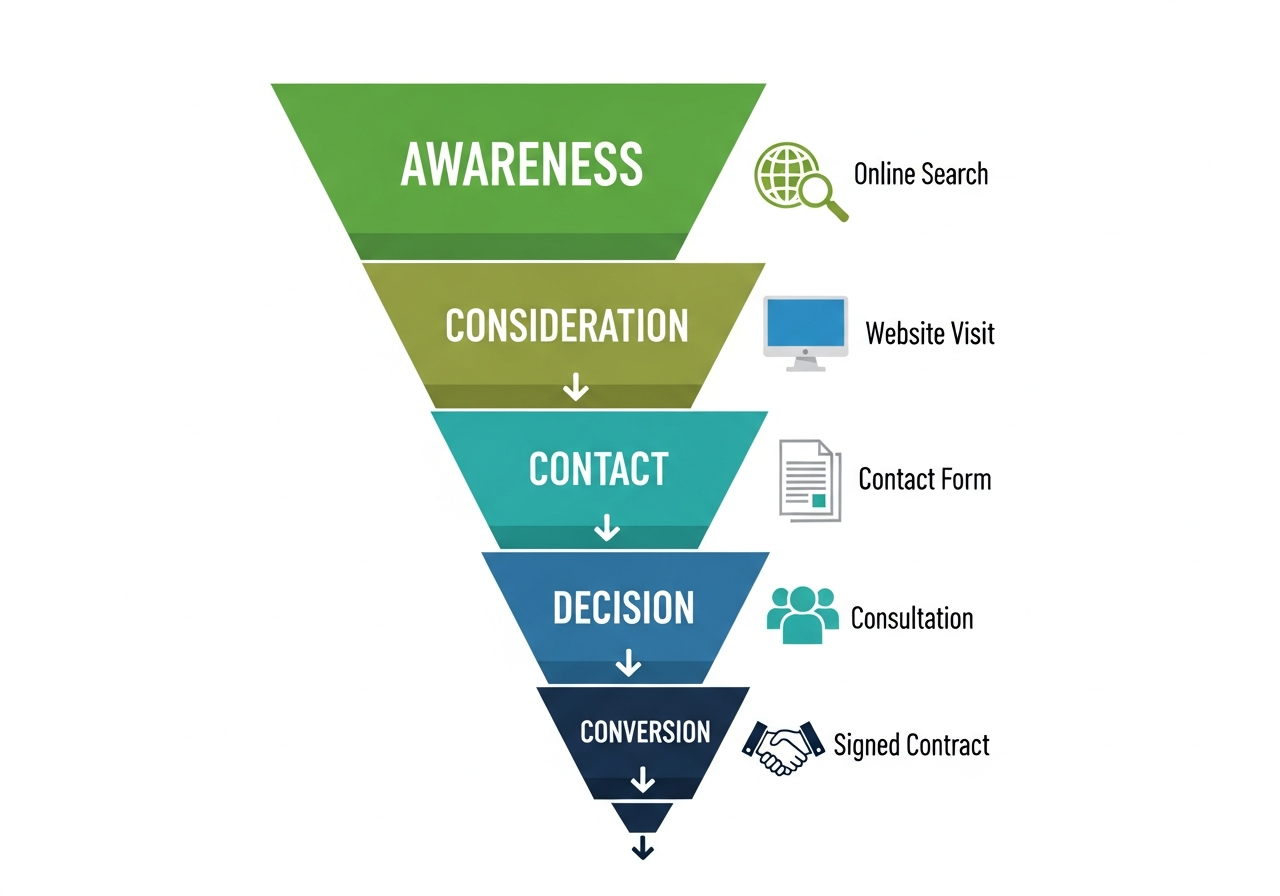
The sales funnel: Awareness, Consideration, Contact, Decision, Conversion
The five-minute window after a lead submission is crucial in determining whether you secure a new client or lose them to competitors. Research shows that leads contacted within five minutes convert up to eight times more often than those reached later.
Consider how many leads you might lose if your average response time is ten minutes and calculate the potential revenue impact.
For instance, by improving your response time from 10 to 5 minutes, even securing just 1 extra client per week could significantly boost your business. If each client generates $1,000 in revenue, that will add $52,000 to your bottom line annually. This illustrates the compounding gains of fast responses, reinforcing the urgency of streamlining your inquiry-handling process.
Leveraging SMS Triggers and AI Booking Tools
Automation tools eliminate response delays that cost your business valuable opportunities. SMS triggers send immediate text responses as soon as inquiries arrive.
AI booking systems let customers schedule estimates without waiting for staff availability. These tools operate continuously, capturing leads during evenings and weekends.
| Response Time | Conversion Rate | Lead Quality | Recommended Action |
|---|---|---|---|
| Under 5 minutes | Highest (70%+) | Excellent | Immediate follow-up |
| 5-30 minutes | Moderate (40-50%) | Good | Automated booking |
| 30+ minutes | Low (under 20%) | Poor | Aggressive recovery |
| Next day | Minimal (under 5%) | Cold | Re-engagement needed |
Strategies to Prevent Lead Decay
Lead decay occurs when inquiry quality declines over time. Automated sequences sustain engagement, allowing you to focus on delivering service.
These systems immediately acknowledge inquiries and provide the user with helpful information. They set clear expectations for next steps, guiding potential customers toward booking without requiring constant owner involvement.
Your business can capture leads at their moment of highest intent, ensuring you don't miss opportunities due to timing constraints.
Digital Marketing for Landscapers: Building Your Online Presence
A strong digital marketing foundation starts with two essential components: your website and Google Business Profile. Together, they form the core of your online presence and attract local clients.
Developing a Professional Website and Local SEO
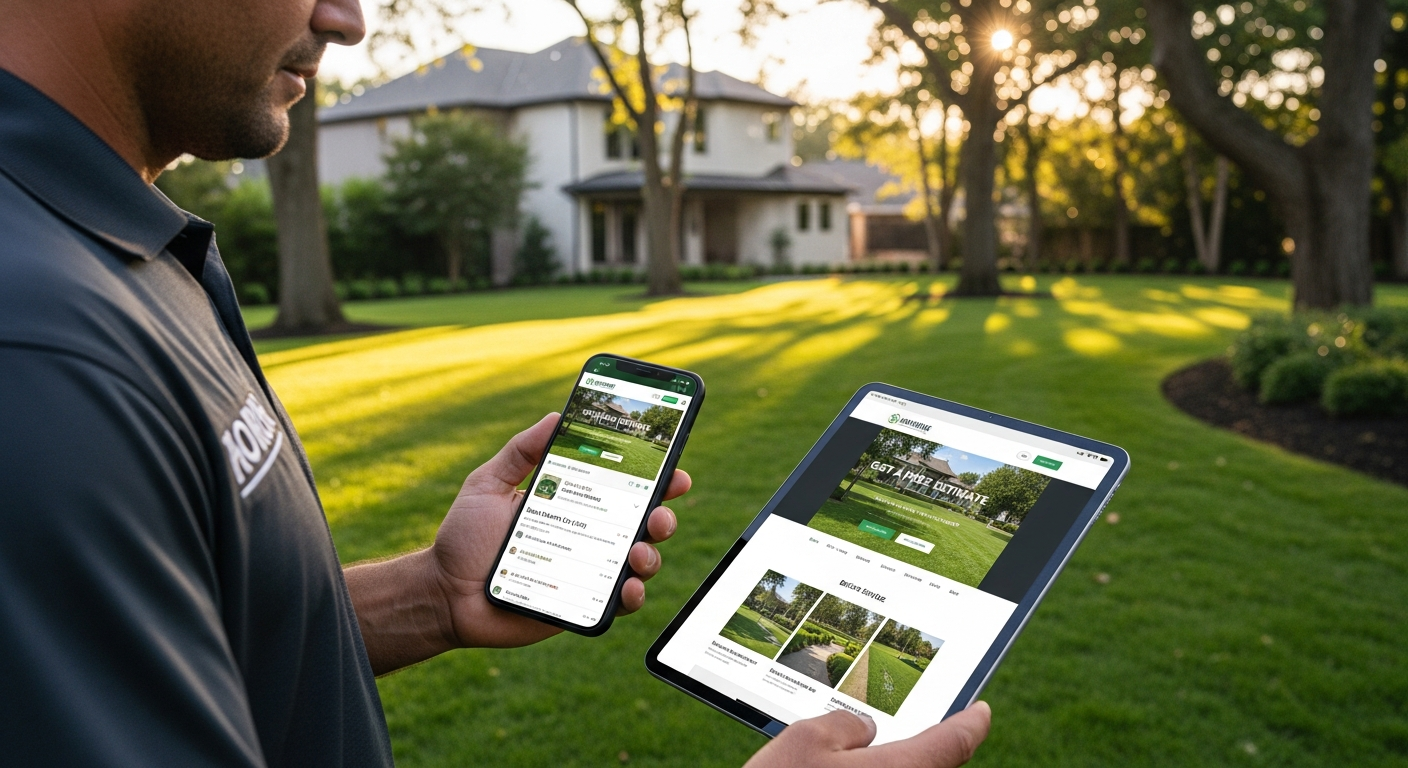
Your website is the central hub for your landscaping business. With over 63% of web traffic coming from mobile devices, mobile responsiveness is essential.
As an experiment, load your homepage on your mobile device right now and time how long it takes to appear. Does it load quickly and navigate easily? This real-time insight will help you determine if your site meets current mobile user expectations.
Visitors expect fast loading times and easy navigation. Provide clear service descriptions and compelling before-and-after photos. Implement local SEO marketing strategies to improve your visibility in local searches.
| Marketing Component | Primary Function | Key Optimization Areas | Impact on Visibility |
|---|---|---|---|
| Website | Showcase services and expertise | Mobile design, load speed, content | Organic search rankings |
| Google Business Profile | Local discovery and reviews | Complete information, photos, updates | Local pack appearances |
| Local SEO | Geographic targeting | Citations, location pages, keywords | Map and local results |
Optimizing Your Google Business Profile
Your Google Business Profile appears prominently in searches for landscaping services. Complete every field with accurate information and select the appropriate service categories.
According to Google, businesses with photos receive up to 42% more direction requests and 35% more website clicks, making profile optimization one of the highest-ROI actions for generating consistent local leads.
Together, these elements establish credibility and support your digital marketing efforts.
Harnessing Data-Driven Decisions for Your Lead Strategy
Identifying which digital marketing channels deliver profitable clients turns guesswork into strategic investment. Many service companies waste resources on unproductive approaches. Growth requires clarity on what works. Attribution tools connect spending directly to revenue, revealing actual costs and returns.
Do you know which of your advertisements generated your last $10,000 patio project? This underscores the need for effective tracking tools.
Consider running a 'stop spending' experiment by pausing one ad platform for two weeks and monitoring the impact on signed contracts. This provides valuable insight into your marketing effectiveness and allows attribution data to guide decisions.
To begin tracking data, use straightforward attribution tools such as 'CallRail' and 'Google Analytics.' These user-friendly platforms require minimal technical knowledge and help you monitor lead sources and evaluate how effective your digital marketing really is.
Measuring Cost Per Lead and Customer Acquisition Cost
Two numbers tell you whether your marketing is actually working: Cost Per Lead (CPL) and Customer Acquisition Cost (CAC). They look similar, but they measure different stages of your sales funnel — and understanding how they connect is where the real insight lives.
➔ CPL tells you how much you spend to generate a single lead. It includes your ad spend, platform fees, and any management costs for that channel, divided by the number of leads it produced.
➔ CAC goes deeper. It captures the total cost of turning a lead into a paying customer — not just ad spend, but also your sales team's time, CRM software, follow-up calls, estimate visits, and overhead. Because not every lead converts, CAC is always higher than CPL.
Cost Per Lead (CPL)
CPL = Total Marketing Spend ÷ Number of Leads
Example
Google Ads spend: $2,000/mo
Leads generated: 25
CPL = $2,000 ÷ 25 = $80 per lead
Customer Acquisition Cost (CAC)
CAC = Total Sales & Marketing Cost ÷ New Customers
Example
Ad spend + sales labor + software: $5,000/mo
New customers signed: 8
CAC = $5,000 ÷ 8 = $625 per customer
How CPL and CAC Are Connected
Here is the relationship most landscaping companies miss: CAC = CPL ÷ Lead-to-Customer Conversion Rate. If your CPL is $80 and you close 32% of your leads, your true CAC is $250. That one formula shows exactly why improving your close rate is just as important as lowering your ad costs.
The CPL-to-CAC Bridge
CAC = CPL ÷ Conversion Rate
$80 CPL ÷ 0.32 close rate = $250 CAC
Compare CAC to Customer Lifetime Value
Knowing your CAC is only half the picture. The real question is whether it pays off over time. Compare your CAC to your Customer Lifetime Value (CLTV) — the total revenue a customer brings you across all their years of service. A healthy benchmark is a 1:3 ratio or better. If your CAC is $625 and the average customer is worth $2,000+ over their lifetime, your marketing is sustainable. If those numbers are closer to 1:1, you are barely breaking even on acquisition.
Healthy CAC-to-CLTV Ratio
CAC
$625
:
CLTV
$1,875+
= 1:3 or better
A quick note on terminology: You may see the acronym CPA (Cost Per Acquisition) used interchangeably with CAC. Depending on the platform, CPA can refer to the cost of acquiring a lead or a customer. In this article, we use CPL for leads and CAC for customers to keep things clear.
Connecting Attribution Tools to Boost ROI
Implement systems that track the customer journey from initial contact to conversion. These tools identify which touchpoints drive sales, securing accurate attribution.
The lowest-cost lead sources are often the least profitable. Low-cost leads frequently come from unqualified prospects who consume sales time but do not convert.
| Digital Marketing Channel | Cost Per Lead | Conversion Rate | Customer Value |
|---|---|---|---|
| Google Business Profile | $45 | 35% | $2,800 |
| Paid Social Media | $28 | 22% | $1,900 |
| Direct Mail | $62 | 18% | $2,100 |
| Local Partnerships | $35 | 42% | $3,200 |
This approach eliminates unprofitable channels and reinvests in proven ones. Quality leads justify their cost through higher conversion rates and larger project values.
This data-driven approach helps you cut unprofitable channels and reinvest in proven performers.
Beyond Digital Marketing: Integrating Social Media and PPC Strategies
Social media channels offer authentic engagement opportunities that complement your website's presence. Together, these platforms create a comprehensive ecosystem for reaching homeowners.
To start your social media strategy, adopt a weekly 'Digital Marketing Monday' routine. Spend 15 minutes creating a three-post plan: share a before-and-after project photo, include a brief client testimonial, and offer a seasonal landscaping tip. This gives busy owners an accessible way to engage their audience effectively.
Weekly 3-Post Plan
Digital Marketing Monday
Monday
Before & After Photo
Post a side-by-side transformation of a recent project. Show the yard before your crew arrived and the finished result.
Wednesday
Client Testimonial
Share a short quote or review from a happy customer. Tag them if possible and include a photo of their property.
Friday
Seasonal Tip
Offer a quick, helpful lawn care tip for the current season. Position your crew as the local experts homeowners trust.
15 minutes every Monday to plan all three posts for the week
Visual platforms such as Instagram and Facebook are ideal for showcasing your landscaping work. Research shows that posts with images generate over twice the engagement of text-only updates, and photo posts on Facebook can earn about 35% more engagement. This demonstrates the importance of visual content in driving audience interaction.
Share before-and-after transformations to demonstrate your capabilities. Customer testimonials and landscaping tips build trust with potential clients.
Visual platforms like Instagram and Facebook showcase your best work effectively.
What engagement benchmarks should you strive for? Engagement rates vary by industry and audience, but the figures below provide reliable current reference points for Instagram and Facebook. In general, strive to post photos which have a significantly higher engagement than plain text.
| Metric / Recommendation | Data / Target |
|---|---|
| Instagram Average Engagement | ~0.45% engagement rate (2025 benchmark) |
| Facebook Average Engagement | ~0.06%–0.2% engagement rate |
| Visual content vs text engagement | Posts with images often receive ~2.3x more engagement than text-only posts |
| Visual content share likelihood | Images are ~40x more likely to be shared than text |
| Engagement impact of visual placement in content | Interactive content generates 2x more conversions than static content |
| Recommended Posting Frequency | ~3–5 posts per week for strong growth |
| Follower Growth Goal | Target ~1–3% monthly follower growth (local service guideline) |
Source: Adobe Express, Marketing LTB, Amra & Elma, RivalIQ
Enhancing PPC Performance for Immediate Impact
Pay-per-click (PPC) advertising provides immediate visibility when homeowners search for landscaping services. With precise location and intent-based targeting, ads reach customers who are actively seeking to hire.
For businesses launching their first campaign, a starting budget of $500 to $1,000 per month is usually sufficient to test keywords, evaluate lead quality, and optimize performance. Well-structured campaigns often yield returns of two times or more, though results vary by competition, follow-up speed, and conversion rates.
| Marketing Strategy Type | Primary Goal | Engagement Level | Conversion Rate |
|---|---|---|---|
| Organic Social Media | Build community relationships | High engagement | Gradual growth |
| Paid Social Ads | Immediate visibility | Targeted reach | 9.21% average |
| PPC Advertising | Capture active searchers | High intent | Immediate results |
Integrate these approaches into your overall digital marketing strategy for maximum impact. Consistent content across channels strengthens your brand message.
Adapting to Changing Market Trends in the Digital Marketing Era
Modern homeowners increasingly rely on social proof before making service decisions. For example, think of a homeowner scrolling through landscaping company reviews late at night. They feel overwhelmed by the number of choices. Discovering a company with glowing testimonials and detailed review histories can ease their anxiety about making the right decision.
Seeing a reassuring five-star review such as, 'We couldn't be happier with our outdoor oasis!' provides the confidence needed to schedule a consultation. This shift impacts how landscaping companies build credibility and attract new customers.
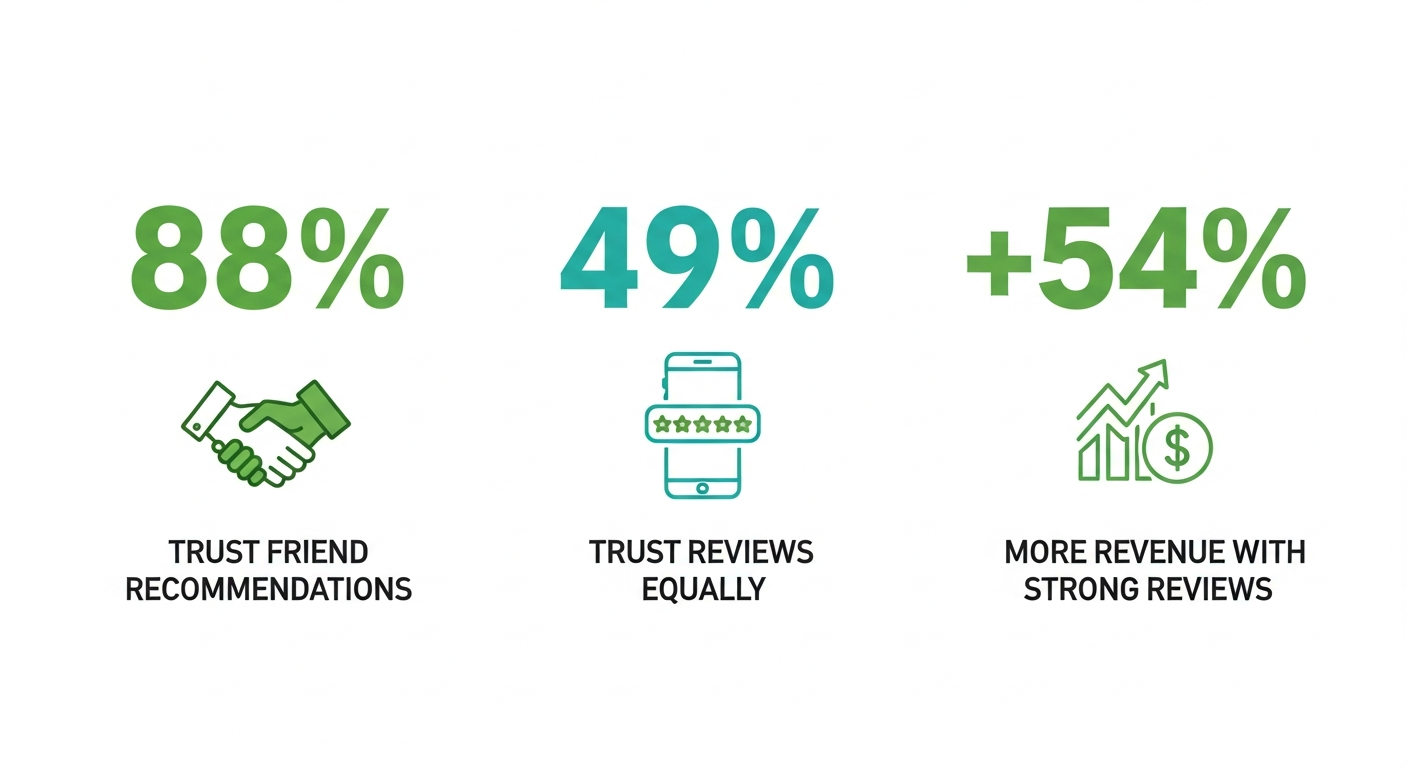
Online reviews now carry almost as much weight as personal recommendations. Research shows that 88% of people trust recommendations from friends, while 49% trust online reviews as much as personal recommendations from family and friends.
In many industries, companies with a stronger review presence tend to generate far more revenue than those with fewer reviews — with some analyses suggesting income up to 54% higher among businesses with abundant positive reviews compared with competitors with fewer reviews.
Incorporating Reviews, Testimonials, and Community Engagement
Request reviews immediately after project completion, when satisfaction is highest. We suggest within 24-72 hours. Automated email or SMS requests make the process easy for customers.
Respond professionally to all feedback, demonstrating that you value input. This builds trust even when occasional negative reviews appear.
Showcase testimonials on your website and social media. This social proof reduces perceived risk for potential customers by evaluating your services.
Community engagement strengthens your local presence. Sponsoring events and partnering with complementary home service businesses positions your company as a trusted community member.
This comprehensive approach to reputation management is a crucial part of your marketing strategy. It builds customer loyalty and generates recurring revenue through maintenance services and referrals.
The Path to Dominance: Your 2026 Landscaping Marketing Roadmap
The most successful landscaping businesses build integrated systems where their website, Google Business Profile, and local SEO work together with content marketing, automation tools, and data analytics. This creates a powerful marketing strategy that attracts qualified leads and drives meaningful results.
To turn insights into action, commit to improving a single metric over the next 30 days. Whether it's reducing lead response time, increasing Revenue Per Man-Hour (RPM), or boosting your customer review count, focusing on one specific goal will bridge the gap between strategy and execution.
Implementation is a progressive journey, not a one-time event. Start with core components such as your online presence and review generation, then add advanced tactics as your company matures.
Frequently Asked Questions
How can a strong online presence help my landscaping business grow?
A robust online presence helps potential customers find your services easily. By optimizing your website and Google Business Profile, you appear in local searches when homeowners need landscaping help. This builds trust and generates more qualified leads for your company.
What is the most important element for my landscaping website?
The most critical element is a clear, easy-to-use lead form. Your site should showcase high-quality photos of your work and include strong reviews. This combination encourages visitors to contact you, increasing conversions for your service business.
Why should I focus on local SEO strategies?
Local SEO ensures your business appears in search results for people in your service area. Using relevant keywords and maintaining an optimized Google Business listing puts your company in front of local clients actively searching for landscaping services.
How do social media and PPC ads work together for landscapers?
Social media platforms like Facebook and Instagram are perfect for showcasing your projects and building your brand. PPC ads can then target those engaged users, driving immediate traffic to your site for quick results and new customers.
What role do customer reviews play in my marketing?
Reviews are social proof that builds credibility. Positive feedback on your Google Business Profile and website reassures potential clients of your quality and reliability. This directly influences their decision to choose your company over competitors.
How can I measure the success of my marketing efforts?
Track key metrics like cost per lead and customer acquisition cost. Using tools to monitor where your leads come from helps you understand your ROI. This data allows you to refine your strategy for better performance.
Ready to Grow Your Landscaping Business?
Stop guessing and start growing. Get a free audit of your current marketing and find out exactly where you're leaving leads on the table.
Get Your Free Marketing Audit