AI Visibility Score Calculator: What It Means for Landscapers, Suppliers & Equipment Brands
Something big is happening in search. When a property manager types "best commercial landscaping company near me" into ChatGPT, Perplexity, or Google's AI Overview, the answer doesn't come from a list of ten blue links anymore. It comes from a single, synthesized paragraph and the businesses mentioned in that paragraph win the customer. The rest? They're invisible.
This shift impacts every corner of the green industry, not just local landscapers, but the fertilizer brands they buy from, the nurseries that supply their plant material, and the equipment manufacturers whose mowers and blowers power every crew. The question every business in this ecosystem should be asking is: Does AI know I exist?
What the AI Visibility Score Actually Measures
The AI Visibility Score is a weighted metric built on three pillars that determine whether AI engines recommend your business. Each pillar measures a different dimension of how AI "understands" your brand:
Citation Frequency (40%)
How often AI models mention your business when answering relevant questions. This is driven by how many authoritative sources reference you online.
Sentiment & Descriptor (30%)
The tone and language AI uses when describing your business. Words like "trusted," "reliable," and "industry-leading" signal positive sentiment.
Entity Confidence (30%)
How clearly AI connects your brand name to your specific services, products, and service area. Strong entity confidence means zero confusion about who you are and what you do.
Together, these factors produce a score from 0 to 100 that tells you exactly where you stand in the AI-powered search landscape. Use the calculator below to estimate yours.
Interactive Tool
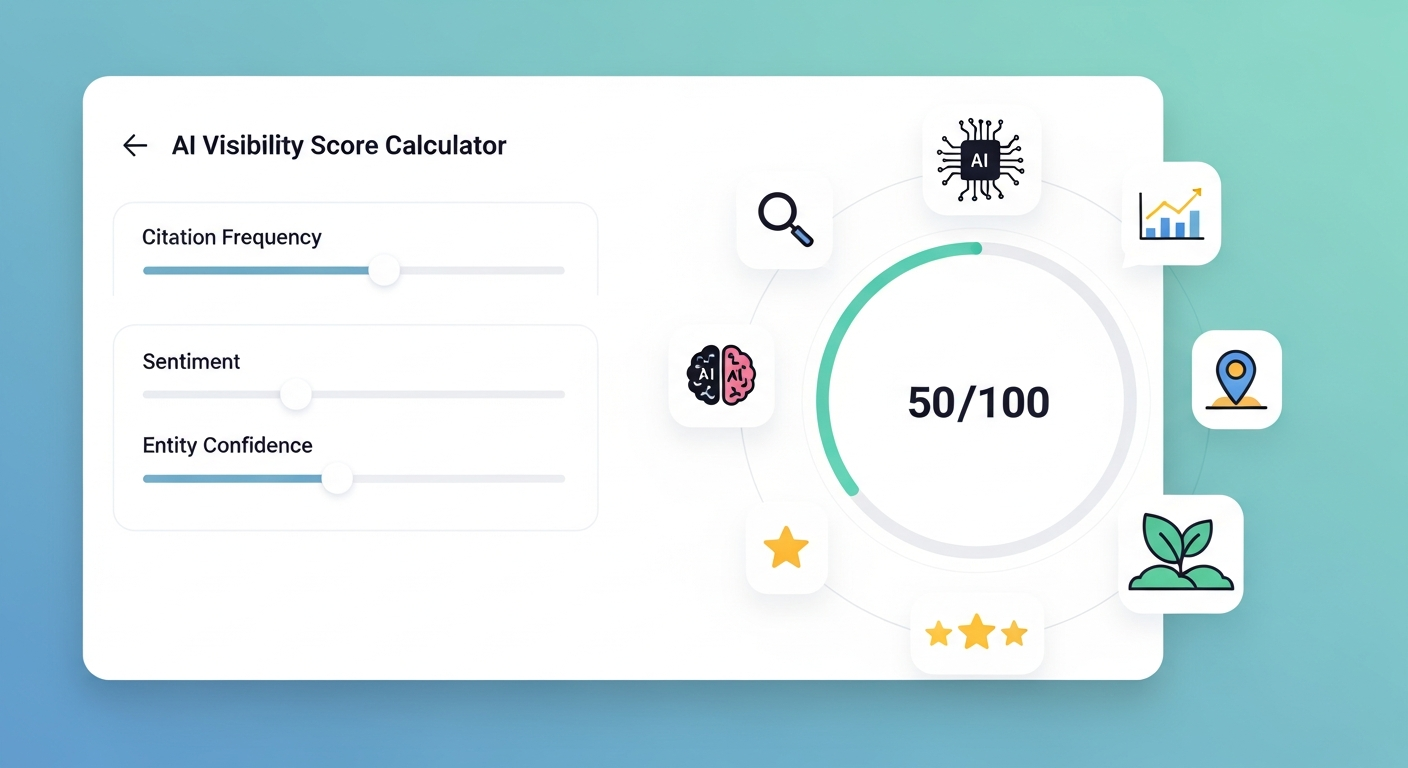
AI Visibility Score Calculator
Adjust the sliders to estimate your AI Visibility Score using the formula above.
How often AI mentions your business (weight: 40%)
How positively AI describes your business (weight: 30%)
How consistently AI recognizes your brand (weight: 30%)
Formula
(50 × 0.4) + (50 × 0.3) + (50 × 0.3)
Your AI Visibility Score
50%
Emerging Presence
0 - 20
Invisible
21 - 50
Emerging
51 - 80
Category Leader
81 - 100
Entity Dominance
Industry Example #1: The Local Landscaper
Scenario: "Premier Grounds," a full-service landscaping company in Charlotte, NC, runs five crews and generates $1.8M annually. They've relied on Google Ads and word-of-mouth for years. But their website hasn't been updated since 2021, and their Google Business Profile has only 12 reviews.
Estimated AI Visibility Score: 28/100 — Invisible
When someone asks an AI assistant "Who does the best landscaping in Charlotte?", Premier Grounds doesn't appear. Their citation frequency is low because few third-party sources mention them. Their sentiment score is neutral since there isn't enough review content for AI to form a strong opinion. And their entity confidence is weak since AI can't confidently distinguish them from the dozen other companies with similar names and generic service descriptions.
What would move the needle: Building 50+ Google reviews with specific service mentions ("Premier Grounds did an incredible patio installation"), getting featured in local business publications, and creating detailed service pages for each offering with location-specific content. These signals teach AI exactly who Premier Grounds is and why they should be recommended.
Industry Example #2: The Fertilizer Brand
Scenario: "TurfBlend Pro" manufactures professional-grade fertilizer blends for lawn care operators across the Southeast. They sell through distributors and have a functional but unremarkable website. Their products appear on a few distributor catalogs, but they've never published educational content or been cited in industry publications.
Estimated AI Visibility Score: 19/100 — Invisible
Ask ChatGPT "What's the best professional fertilizer for warm-season turf?" and TurfBlend Pro is nowhere in the answer. AI recommends the brands that have been written about in trade publications, mentioned in lawn care forums, and referenced in university extension research. Without those citations, AI has no reason to surface TurfBlend Pro, no matter how good their product actually is.
What would move the needle: Publishing original agronomic research on their blog, partnering with turf management programs at state universities, sponsoring and presenting at industry conferences like GIE+EXPO, and encouraging distributors to write product comparison content that names TurfBlend Pro specifically. Every one of these actions creates a citation that AI models can reference.
Industry Example #3: The Green Industry Supplier
Scenario: "SouthEast Nursery Supply" is a wholesale plant supplier that services landscapers across Georgia and the Carolinas. They have a strong reputation among their existing customers but almost no digital footprint beyond their website and a LinkedIn page with 200 followers.
Estimated AI Visibility Score: 22/100 — Invisible
When a landscaper asks Perplexity "Where can I buy Zoysia sod in bulk near Atlanta?", SouthEast Nursery Supply doesn't appear. The AI suggests competitors who have better-structured product catalogs online, more directory listings, and published growing guides that AI models have ingested. SouthEast's real-world reputation counts for nothing if AI can't find the evidence.
What would move the needle: Creating a searchable online plant catalog with detailed species information, publishing seasonal availability guides that landscapers would bookmark and share, getting listed in industry directories like the American Nursery & Landscape Association, and building a resource library of planting guides tied to their specific growing region.
Industry Example #4: The Equipment Producer
Scenario: "IronCut Outdoor Equipment" manufactures commercial zero-turn mowers from their facility in Indiana. They sell through a dealer network of 40 locations and have a polished website with spec sheets and dealer locator. But they don't produce any content marketing, and their social media is mostly product photos with low engagement.
Estimated AI Visibility Score: 35/100 — Emerging Presence
IronCut scores slightly higher than the others because their dealer network creates natural citations across 40 different websites. But when someone asks an AI "What's the best commercial zero-turn mower for large properties?", the answer still defaults to Hustler, Scag, or Exmark since brands with decades of forum discussions, YouTube comparisons, and trade publication reviews baked into AI's training data.
What would move the needle: Launching a YouTube channel with head-to-head comparison tests, sponsoring independent equipment reviewers, publishing total cost-of-ownership calculators, and creating detailed use-case content like "Best mowers for HOA common areas" or "Zero-turn vs. stand-on for steep slopes." This kind of content becomes the source material AI uses to form recommendations.
The Pattern Across All Four Examples
Whether you're mowing lawns, blending fertilizer, shipping plant material, or manufacturing mowers, the path to AI visibility follows the same formula:
- ➔ Be cited — Get mentioned on authoritative websites, directories, publications, and forums that AI trains on.
- ➔ Be described positively — Earn reviews, testimonials, and editorial mentions that use strong, positive language about your brand.
- ➔ Be unmistakable — Create enough structured, specific content that AI can confidently connect your brand name to your exact products, services, and market.
The businesses winning in AI search aren't necessarily the biggest or the oldest. They're the ones that have built a digital presence so clear and well-referenced that AI engines have no choice but to recommend them. Your real-world reputation is only as valuable as the digital evidence that supports it.
What Should You Do Next?
Start by using the calculator above to estimate where your business falls today. Be honest with yourself about each slider. Then ask: What would it take to move each score by 10 or 20 points? For most green industry businesses, the answer involves three to five focused actions over the next 90 days, not a complete overhaul.
The companies that start optimizing for AI visibility now will have a compounding advantage. Every citation, every review, and every piece of structured content you publish today becomes training data for the AI models of tomorrow. The longer you wait, the further ahead your competitors get.
Find Out Where You Stand in AI Search
Turf Pro Digital helps landscapers, suppliers, and green industry businesses build the digital presence that AI engines trust. Get a free audit of your current AI visibility and a custom action plan.
Get Your Free AI Visibility Audit ➔